

Shop Tri-Spark ignition systems and charging components for vintage Triumph, Norton and BSA motorcycles at The Bonneville Shop. Made in Australia, the range includes the Tri-Spark Classic Twin electronic ignition for British twins and singles, ignitions for Triumph Trident and BSA Rocket 3 triples, a magneto replacement kit, 4V, 6V and 12V Lucas-type ignition coils, a 12V dual-lead coil and a 20-amp MOSFET regulator/rectifier. Each Tri-Spark ignition replaces the contact breaker points with solid-state triggering, so there are no points to adjust or wear. Before ordering, compare each listing’s model applications, earth polarity and coil requirements. Browse the Tri-Spark products below, or explore our full range of electronic ignitions and British motorcycle electrical parts.

Triumph BSA Norton Tri-Spark Electronic Ignition Kit W/Coils Option PN# TBS-1006 TBS-3586 A 45275 A
$473.23 – $531.68Price range: $473.23 through $531.68


Tri-Spark 6 Volt 6V 40mm Ignition Coil(s) Triumph Norton BSA Lucas-Type PN# 45275 A
$83.10 – $157.95Price range: $83.10 through $157.95

Tri-Spark 4 Volt 4V 40mm Ignition Coil(s) Triumph BSA Lucas-Type PN# TBS-0029
$75.80 – $214.31Price range: $75.80 through $214.31

Trispark Tri-Spark 12 Volt 40mm Ignition Coil(s) Triumph Norton BSA Lucas Type PN# 45276 A
$83.10 – $157.95Price range: $83.10 through $157.95
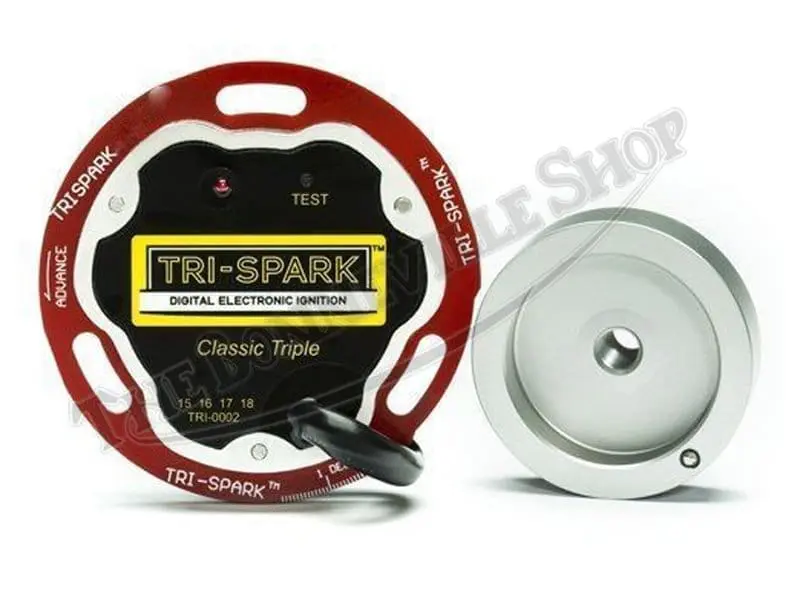
Table of Contents
About Tri-Spark Ignition
Tri-Spark designs and manufactures electronic ignition and charging products for classic motorcycles in Australia. Its main products for British machines are the Classic Twin ignition for twins and singles, ignition systems for Triumph and BSA triples, magneto replacement kits, Lucas-style ignition coils and MOSFET voltage regulator/rectifiers. Tri-Spark also makes ignition systems for BMW, Moto Guzzi, Yamaha, Vincent, Velocette and Honda motorcycles. You can see the full manufacturer range on the official Tri-Spark website.
The Bonneville Shop stocks the Tri-Spark components most often used on vintage Triumph, Norton and BSA motorcycles. Choose parts by application, not by make alone: a 50-year-old motorcycle may have been converted from 6V to 12V, rewired with a different harness, changed from positive to negative earth, or fitted with non-original coils.
Tri-Spark Classic Twin Electronic Ignition
The Tri-Spark Classic Twin (TRI-0006) replaces the original contact breaker points plate, auto advance unit and points cam. Its stator unit and trigger rotor fit inside the timing chest, so there is no separate external “black box” ignition module.
Listed applications include Triumph unit twins (T100, T120, TR7RV, T140 Bonneville, Tiger and Daytona), Norton Atlas and Norton Commando 1968–75, BSA unit twins (A50/A65), BSA B25 and B50 singles, Triumph Tiger Cub singles and Royal Enfield Interceptor twins. The system is designed for 360-degree parallel twins. Engines with offset cranks, such as 270-degree conversions, need a modified trigger rotor. Contact us with your engine details before ordering.
Key Classic Twin features:
- 12V system that works with positive- or negative-earth wiring. It is supplied wired for positive earth, the more common classic British setup.
- Built-in self-test mode and an LED for setting the static timing.
- Senses direction and speed of rotation to help the engine start without kickback, which also protects electric-start mechanisms.
- Tri-Spark lists a nominal 12V operating voltage, with a range of 8V to 16V.
- Includes the stator unit, trigger rotor, an illustrated instruction booklet and fitting hardware.
Polarity matters. On a negative-earth motorcycle, the stator terminals must be swapped as described in the instructions. Connecting the module the wrong way round can damage its output transistor. Watch our video and read our guide to timing the Tri-Spark Classic Twin ignition before you install.
The Classic Twin is available alone or as a kit with coils. The kit offers either two Tri-Spark 6V 40mm coils, wired in series at about 4.4 ohms, or one 12V dual-lead coil at 3.6 ohms.
Tri-Spark Ignition for Triumph Trident and BSA Rocket 3 Triples
Tri-Spark triples ignitions are listed for 1968–75 Triumph T150 and T160 Trident and BSA A75 Rocket 3 750 triples. One listing also includes the Triumph X75 Hurricane. The under-cover version mounts entirely beneath the points cover with no external box and has a built-in test feature. The manufacturer’s current Classic Triple Mark 2 is also listed for Trident, Rocket 3 and Hurricane engines.
The Tri-Spark triples system works differently from points and from Boyer Bransden ignitions. Those systems fire all three plugs at once through coils wired in series. The Tri-Spark system fires one plug at a time, through three 12V coils, and needs its own wiring arrangement. Our technician’s Tri-Spark triples ignition installation guide explains positive- and negative-earth wiring and timing. It also explains why we don’t recommend 6V coils with a ballast resistor on bikes with single-phase charging systems.
Tri-Spark Magneto Replacement Kit
The Tri-Spark 12V magneto replacement kit replaces Lucas three-bolt-flange magnetos such as the K2F, K1F and KVF. These were fitted to BSA A7 and A10 twins, pre-unit Triumph twins, Norton Atlas and some Velocette models. The kit includes a billet alloy housing, a Classic Twin ignition, a dual-output coil and spark plug caps. Spark advance is electronic, so there are no springs or weights, and the LED timing light is built in.
Unlike a magneto, this system needs a battery. A 4 Ah battery suits most applications. You also need a solid magneto drive gear (not included), and a charging system that will keep the battery charged. See our motorcycle batteries and charging system parts, and read our guide to converting a 6-volt British motorcycle to 12 volts if your motorcycle still uses 6V electrics.
Tri-Spark Ignition Coils
Tri-Spark coils have extra windings, heavier wire and a high-grade core for improved spark energy and duration. The 40mm Lucas-type coils match the dimensions of later Lucas 17M6 and 17M12 coils and fit standard 40mm coil brackets.
| Coil | Typical use according to the product listings |
|---|---|
| 6V 40mm Lucas-type (45275 A) | Pairs wired in series on 12V British twins with electronic ignition, and 6V points systems |
| 12V 40mm Lucas-type (45276 A) | 12V points systems and electronic ignitions on singles and some triples, including the three-coil Tri-Spark triples ignition |
| 4V 40mm Lucas-type (TBS-0029) | Sets of three for Triumph and BSA triples fitted with Boyer Bransden electronic ignition |
| 12V dual-lead (IGC-2012) | Twin-cylinder bikes using Tri-Spark, Boyer, Pazon or Sparx electronic ignition; 3.6-ohm primary |
The coil voltage rating is not the same as the motorcycle’s system voltage. Two 6V coils wired in series are standard on many 12V twins. Primary resistance also affects timing, so match the coils to the ignition’s instructions. Tri-Spark’s ignition coil troubleshooting guide covers coil testing. You’ll find more options in our ignition coils and spark plugs and leads ranges, as well as Champion spark plugs.
Tri-Spark MOSFET 20-Amp Regulator/Rectifier
The Tri-Spark MOSFET regulator/rectifier (VR-0030) is a 12V, 20-amp charging module for alternator-equipped classic British motorcycles. It works with single- and three-phase stators, including Lucas and pattern 10A RM21, 16A RM23 and 14.5A RM24 types. It can replace the original plate rectifier and Zener diode, or an older solid-state regulator.
MOSFET regulation runs cooler than conventional diode regulators and doesn’t need direct airflow, so the compact unit (80 × 67 × 20 mm) can go under the seat or behind a side cover. Low electrical noise also helps electronic ignitions run without misfires. Tri-Spark lists a two-year warranty. See Tri-Spark’s tech tip on installing and optimising the MOSFET regulator, and compare it with our regulators and rectifiers, Podtronics regulator/rectifiers and Tympanium voltage regulators.
Tri-Spark vs. Other Electronic Ignition Brands
The Bonneville Shop also stocks Boyer Bransden electronic ignition, Sparx electrical parts and Electrex World ignition and alternator kits. The main differences are packaging and wiring. Tri-Spark’s Classic Twin and under-cover triples ignition fit inside the timing cover with no external box, while the Boyer systems use a separate module. Coil requirements differ too, so don’t assume coils, wiring or timing settings carry over from one brand to another. If you’re keeping the original setup, browse our points ignition parts and Lucas electrical parts.
How to Choose the Correct Tri-Spark Part
Before ordering, confirm:
- Make, model, year and engine type: single, 360-degree twin, offset-crank twin or triple.
- Whether the bike currently uses points, a magneto or another electronic ignition.
- System voltage (6V or 12V) and earth polarity (positive or negative).
- Coil type, voltage and primary resistance.
- Charging system: stator type, single- or three-phase, and regulator.
- Battery condition and capacity, especially for magneto conversions.
- Any previous wiring changes, such as aftermarket wiring harnesses or British Wiring components.
Check original fitment in our Triumph parts books, Norton parts books or BSA parts books. Wiring diagrams and timing procedures are in our Triumph manuals, Norton manuals and BSA manuals. For the installation itself, see our electrical tools and the brand-specific Triumph, Norton and BSA service tools.
Because electrical items are not returnable, please ask any fitment questions before you buy. Review our shipping and returns policy, then contact The Bonneville Shop with your model, year, voltage, earth polarity and any known electrical modifications.
Related Electrical Categories
- Triumph electrical parts
- Norton electrical parts
- BSA electrical parts
- Electronic ignitions
- Ignition coils
- Regulators and rectifiers
- Batteries
- Switches
- All motorcycle brands we stock
Tri-Spark Technical References
From The Bonneville Shop Tech Blog:
- Timing Tri-Spark Ignition – Classic Twin Ignition
- Easy Tri-Spark Triples Ignition Kit Installation Guide
- Electronic Ignition System Diagnostics
- Using the Degree Wheel to Establish Ignition Timing
- A Look at the Lucas Cutout / Kill Switches
- A Look at the Lucas 149SA and 47SA Ignition Switches
From Tri-Spark (external, manufacturer-hosted):
- Tri-Spark technical support and instruction booklets
- Classic Twin TRI-0006 instruction booklet (PDF)
- Classic Twin TRI-0006 troubleshooting guide (PDF)
- Classic Triple Mark 2 TRI-0002 instructions (PDF)
- Magneto replacement MRK-0001/0003/0005 installation instructions (PDF)
- MOSFET regulator VR-0030 installation instructions (PDF)
- Ignition coil troubleshooting guide (PDF)
- Classic Twin: avoiding a common installation issue
- Tri-Spark on YouTube
Tri-Spark updates its instruction booklets from time to time. Always follow the instructions supplied with your component.
Tri-Spark Ignition FAQs
What is Tri-Spark ignition?
Tri-Spark is an Australian manufacturer of electronic ignition systems, ignition coils and MOSFET regulator/rectifiers for classic motorcycles. Its ignitions replace contact breaker points and mechanical advance units with solid-state triggering and electronic spark advance. That removes the need for points adjustment and condenser replacement.
Which motorcycles does the Tri-Spark Classic Twin fit?
Listed applications include Triumph T100, T120, TR7RV, T140 Bonneville, Tiger and Daytona unit twins; Norton Atlas and 1968–75 Commando; BSA A50/A65 twins and B25/B50 singles; Triumph Tiger Cub; and Royal Enfield Interceptor. Check the product listing and your parts book for your exact model and year.
Does the Tri-Spark Classic Twin work on positive-earth motorcycles?
Yes. The Classic Twin is a 12V system for positive- or negative-earth motorcycles and is supplied wired for positive earth. On a negative-earth motorcycle, the stator terminals must be swapped according to the instructions. Incorrect polarity can damage the module.
Does Tri-Spark ignition need a separate black box?
The Classic Twin and the under-cover triples ignition do not. Their electronics fit inside the timing cover. One triples listing describes an earlier version with an external box, so check the description of the item you are ordering.
Which coils should I use with the Tri-Spark Classic Twin?
For twins, Tri-Spark recommends its 6V high-performance coils, two wired in series, or the 12V dual-lead coil. For singles it recommends a 12V coil. The Classic Twin kit with coils lets you choose either the 6V pair or the 12V dual-lead coil.
Can I use 6V coils on a 12V motorcycle with Tri-Spark ignition?
On twins, yes: two 6V coils wired in series are a common, intended arrangement. On Trident and Rocket 3 triples, the Tri-Spark system is designed around three 12V coils. Its instructions describe a 6V-coil option with a ballast resistor, but we discourage it on bikes with single-phase charging systems.
Does Tri-Spark make an electronic ignition for the Triumph Trident and BSA Rocket 3?
Yes. Tri-Spark triples ignitions are listed for 1968–75 Triumph T150 and T160 Tridents and BSA A75 Rocket 3 750 triples. The X75 Hurricane appears in one listing and in Tri-Spark’s Classic Triple Mark 2 description. Each plug is fired by its own 12V coil.
Can I replace a Lucas magneto with Tri-Spark electronic ignition?
Yes. The Tri-Spark magneto replacement kit replaces Lucas three-bolt-flange magnetos such as the K2F, K1F and KVF, fitted to BSA A7/A10, pre-unit Triumph twins, Norton Atlas and some Velocettes. It needs a battery (4 Ah suits most), a solid drive gear (not included) and a working charging system.
Will the Tri-Spark ignition work with my 6V electrical system?
The Classic Twin and the magneto replacement kit are 12V systems. Motorcycles that still use 6V electrics normally need a 12V conversion first. That can involve the battery, charging components, bulbs and other parts. See our guide to converting a 6-volt British motorcycle to 12 volts.
How do I set the timing on a Tri-Spark ignition?
The Classic Twin has a built-in LED for setting static timing. A strobe timing light is then used to confirm advanced timing with the engine running. Our Tech Blog has a video guide for the Classic Twin and a separate guide for the triples ignition. Coil primary resistance affects timing, so follow the supplied instructions.
What does the Tri-Spark MOSFET regulator/rectifier replace?
It replaces the original plate rectifier and Zener diode, or an older solid-state regulator, on 12V alternator-equipped motorcycles. It’s rated at 20 amps and is compatible with single- and three-phase stators, including Lucas RM21, RM23 and RM24 types. Tri-Spark lists a two-year warranty.
Is Tri-Spark better than Boyer Bransden?
Each system suits different preferences. Tri-Spark’s Classic Twin and under-cover triples ignition fit inside the timing cover with no external module. They also include anti-kickback starting logic and LED timing. Boyer Bransden uses a separate module, and coil requirements differ between the two. Compare application, wiring and coil requirements, or contact us for advice on your motorcycle.