

Mike Grage, Technical and Customer Support at The Bonneville Shop and British Iron
446 LED Update for 2026
There have been a few changes to the parts that are available to us from when I first started working for The Bonneville Shop in July 2021. Back then I was tasked with providing a solution to a common problem with our 446 LED headlamp bulbs. The issue was an out-of-control headlamp circuit when the 446 LEDs are used in motorcycles equipped with a high beam warning light. The high beam would come on or flash high/low when the bike was revved, other times there was no high beam. Of course, removing the high beam warning light stopped the problem.
I recognized the cause, and knew how to cure the issue thanks to my experience with converting incandescent turn signals to LED’s in more modern motorcycles. The incandescent/traditional light bulb will allow for a small, constant current back-flow of electricity that is enough to drive the 446 LED dual polarity bulb crazy. Since LEDs and diodes work like electrical check valves, I knew that using one for the high-beam warning light will prevent this back-flow. Finding the component to make the LED conversion as painless as possible was not easy because I cannot run down to Radio Shack like the good old days.
After finding a usable component we did some bench testing and then added an edit to the Has the 446 LED Main/Dip Beam Tripped You Up. The usable component was a negative ground 281 LED to remedy the problem, I used that solution because there were no positive ground bulbs on the market. I left The Bonneville Shop in 2023 and when I came back in the summer of 2025, I discovered that there is an easier, more painless solution now. That solution is using the dual polarity Lucas 281 LED.
Since a single LED cannot be dual polarity and that sounded too good to be true, I decided to grab my multi-meter and test one to see how they achieved this feat. Turns out they light up at 9V with 34K ohms of resistance in either polarity.
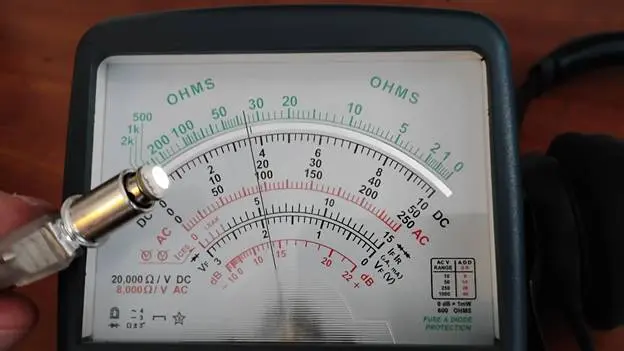
The high resistance prevents the feedback, so the single LED wired in a shunt configuration with some resistors will allow it light up and prevent back-flow. That makes them good for all warning light applications in 12V systems with zero modifications to the socket wiring like what is needed to use the negative ground 281 LED bulb. I understand how the circuitry works because I had three different Radio Shack Science Fair Electronic projects kits when I was growing up, but I’m not going to be long winded and explain it in detail in this blog because it would bore the average reader into darkness.