
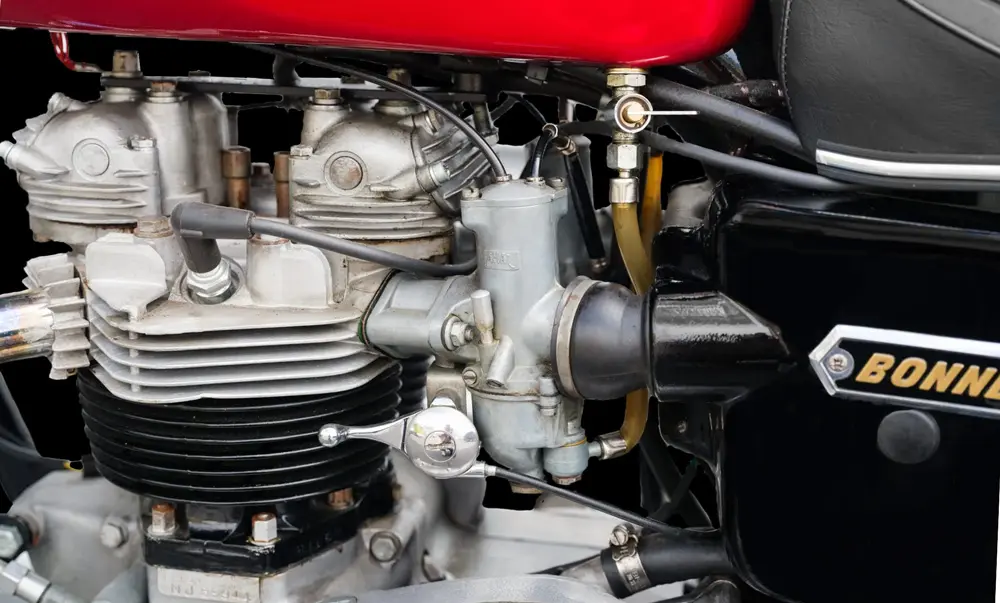
Amal Concentric MK1 Choke

Dave Porter, Customer and Technical Support at the Bonneville Shop
Occasionally, the topic of chokes and their operation on 600 and 900 series Amal Concentric carburetors is brought up on the various internet forums, as well as by customers calling in with unexplained rich running conditions and chronically fouled spark plugs. Rather than another comprehensive Amal carburetor tuning guide, I’d like to offer a brief guide on the use of the choke system on these ubiquitous carburetors found on the majority of British motorcycles from the mid-1960s through the late 1970s. Whether the motorcycle is equipped with a single or twin carburetors, the operation and principles apply to both configurations.
The Amal Concentric is really like two carburetors built into one assembly that consists of a starting circuit and a running circuit, controlled by different functions at different throttle openings. The choke system is an integral part of the starting circuit, which includes the pilot jet and the fuel/air mixture, controlled by the fuel present in the float bowl, the amount of fuel flowing through the pilot jet from the float bowl, and the amount of air mixed with the fuel while the throttle is closed, largely controlled by the position of the pilot air screw, but most certainly affected by the amount of air being drawn into the mixing chamber through the inlet mouth of the carburetor.
The choke block restricts the amount of air that enters the mixing chamber and creates a rich fuel/air mixture that enhances cold-starting the engine. Calibrating the starting stage of the carburetor is critical to the operation of the remaining stages, or circuits, once the throttle is opened up. Many riders deliberately omit the choke(s) from their carburetors in an effort to simplify the operation of the carburetor and throttle.
The omission of the choke system in a twin-carbureted engine is common, especially at higher altitudes, where the thinner air inherently makes for richer running at all stages of throttle openings. Yes, the increased fuel charge from twin carburetors can effectively “trick” the carburetors into starting by simply flooding both float bowls via the plungers, or “ticklers”, but a single carbureted engine almost always requires a choke system to provide the extra-rich air/fuel mixture to compensate for a cold engine…even when the float bowl has been flooded to the point where fuel is weeping out of the plunger bore.
Because the carburetor relies on a fixed mechanical metering of fuel with airflow, it doesn’t automatically adjust for temperature or atmospheric conditions, so a manual choke is employed to choke out the air until the operating temperature of the engine is approached. Once the engine is warmed up enough to idle smoothly, the choke can be disengaged to increase the airflow, allowing the remaining stages of carburetor function to operate as intended, with calibrated jets, throttle valve (slide) cutaway, and needle jet size affecting operation as throttle openings increase.
So how is the choke operated on a vintage Triumph, Norton, or BSA equipped with Amal Concentric carburetors? A choke block (air slide) which fits in the channel of the throttle valve body slides up and down to adjust the level of airflow through the carburetor inlet, mixing chamber, and into the manifold. The block is operated by a cable inserted through the top cap of the carburetor. Further investigation in your parts book will reveal a brass guide sleeve and return spring that wraps around the cable, ensuring smooth operation of the choke block when lifted or dropped within the slide.
The choke cable is controlled by a remote lever, usually clamped onto the handlebar or integrated onto the brake lever perch on some drum-brake models. Triumph T140V models used a curious choke lever mounting arrangement with an “L” bracket fitted to the left intake manifold as the perch for the choke lever.
When the cable is tensioned, the choke block is lifted and provides unobstructed airflow through the carburetor for normal operating temperatures. When the cable tension is released, that is, when the lever is turned anti-clockwise, the choke block is dropped down towards the bottom of the carburetor inlet tract, in the position for cold-starting the engine. The choke is not usually needed to start a warm engine, so this only applies to a cold engine, where the fuel vaporization is less effective, even when the float bowl is flooded.
The choke lever features a special friction washer, or “spring washer”, as specified in the parts books. The friction washer allows the choke lever tension to be adjusted to hold its position when rotated clockwise, or in the off position. This is counterintuitive to many riders, which has led more than a few riders wondering why their engine runs rich no matter what is done with adjustments and jetting, etc. Running the engine in this condition, with the choke obstructing the airflow will result in poor running, excessive fuel consumption, and fouled spark plugs…even worse, when the rider selects spark plugs with a higher heat range in an effort to alleviate the carbon fouling, significant engine damage can occur.


So the takeaway is this:
-A choke should be fitted to your single-carbureted engine to promote easy cold-starting and improved idling while running cold, as it approaches proper operating temperature.
-An understanding of choke system operation is necessary when adjusting the choke lever. This means when the choke is on, the lever will be rotated anti-clockwise, releasing tension on the cable and allowing the choke block to promote a richer fuel/air mixture. Once the engine is warmed up, the choke lever can be rotated to the full clockwise position, which tensions the cable and lifts the choke block out of the way of the inlet, achieving the off position.
-If and when the lever starts to creep anti-clockwise while the engine is running, the central screw on the choke lever can be tightened to hold it’s desired position, as the friction washer will effectively hold the position of the lever without locking it down and fixing the position.
-The choke system can also be useful as a tool when troubleshooting the carburetor(s) in an effort to define a misfire while running at various throttle openings due to a possible rich or lean fuel/air mixture.
I hope you have found this blog useful.