
From Mike Grage: Customer and Technical Support at The Bonneville Shop and British Iron
One of the most discussed subjects that bikers have in online forums, in garages, and on bar stools is the Triumph exhaust system. If the topic is not sound, it is performance. When it comes to engineering/designing a motorcycle exhaust system there are mathematical formulas, materials, weight, and government regulations to consider. With the exception of weight and material I am going to break it all down into each section of the exhaust system for pre-catalytic converter motorcycles. The main thing that determines if an exhaust system is street legal is the decibel output, and the evolution of the decibel limits are covered in the muffler section towards the end of this blog.
The dreaded balance pipe:
May as well go feet first and jump into it with the most hated part of a Triumph exhaust system. Just about everybody who rides a motorcycle has heard the phrase “Loud Pipes Save Lives”, but not everybody realizes that motorcycle exhaust sound levels are regulated by the EPA and other environmental agencies like the California Air Resources Board. CARB did not regulate air pollution from motorcycles until 1975; however, they put an 88 dB limit on the sweet sound that they call noise pollution in 1969.
Triumph, BSA, Norton, and other manufacturers started producing their exhaust systems with balance pipes (crossover, if you prefer) to reduce their noise emission to comply with these new regulations. The balance/crossover and H-pipes on later models reduce noise by slowing down the exhaust gasses.
A balance/crossover pipe is not the same as a 2 into 1 performance exhaust. Bernoulli’s principle does apply like it does in a 2 into 1 system, but it is the polar opposite as a 2 into 1 system. A 2 into 1 collector will speed up exhaust, and a crossover will slow it down.
Back in 1989 the CHP gave me an expensive lesson on the subject. The lesson was that the only street legal exhaust systems for 1969 and later motorcycles in California are the stock exhaust systems. You will take a performance hit from the balance pipe, but it will keep you out of trouble in California and other states with similar noise regulations. Of course, things have changed and there are a lot of modern exhaust systems with CARB executive order exemptions today.
Head pipes:
The head pipe is the part of the exhaust that helps apply the horsepower. The diameter and length matter. A good comparison is how a nozzle on a garden hose will make the water move faster and farther. There are mathematical formulas used to determine the head pipe diameter and length.
Larger diameters and shorter lengths will give better high RPM throttle response at the expense of low RPM torque. One example is the 70-5959/5961 TT pipes. They are 1.75” all the way down and are completely open to allow the engine to run more efficiently at RPM’s closer to the red line. They designed for wide open throttle racing applications and are popular among flat-track racers.
Go for a ride around town with them and you will foul plugs on a regular basis, have trouble leaving a stop light without a good amount of throttle, and make a lot of people happy. Size matters, so too big and too short will cause burnt exhaust valves and reduce scavenging at any RPM.
Smaller diameter and longer will give better low and mid-range throttle response. This is why the head pipes that are intended for street use like the 70-5957/5958 T120/TR6 pipes are typically 1.65” after the spigot and taper to 1.5” on the muffler end. The smaller diameter and tapered design will assist in exhaust scavenging in the cylinder resulting in smoother acceleration in the lower RPM range. It is possible to go too small and too long which will be like putting a banana in a tailpipe in the movie 48 Hours, the exhaust will not be able to exit the cylinders in an efficient manner.
When fabricating an exhaust system for a specific application the length is the first number to be calculated. To get the correct length you need to know the desired RPM (where you want the power applied) and when the exhaust valve opens. The length is a measurement from the valve seat to the muffler or collector. Below is photo of the mathematical formula from my notes from school.

After that you use the length and cylinder displacement to determine the diameter of the head pipe. Since there are a limited number of diameters of exhaust tubing available this calculation is more of a goal. Fabricators have to round up for narrow high RPM power delivery like drag racing or down for wide range and lower RPM power delivery like road racing.

Collectors:
A collector is a part of an exhaust system where the head pipes come together. The length of the collector matters as much as it does for the head pipes, but the angle of where they come together matters more. When one piston is pushing exhaust out on one cylinder, it will draw (start to scavenge) the other cylinder.
The typical angle for collectors is between 7 and 10 degrees. The lower angles (longer) are needed for high RPM efficiency, the higher angles (shorter) are needed low RPM efficiency.
There are not too many 2 into 1 exhaust system in the vintage bike world, however the one example I will use is the 1966 Triumph T100C Tiger. The 70-4513/4514 high exhaust pipes have the right idea for making low and mid-range more useful, but the placement of the collector is not that good.
If you wanted to make your own 2 into 1 performance exhaust system, and are capable of making your own head pipes you can buy pre-fabricated slip-on collectors from a few different companies.
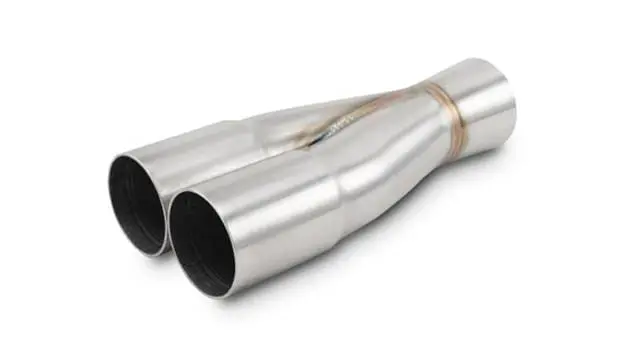
There is no set method of calculating the length of exhaust pipe exiting the collector. That is where you want to start a bit on the long side and gradually shorten it until you get the desired effect.
Silencer/Mufflers:
There are have been several muffler designs to choose from over the years. Chambered mufflers, megaphones, and reverse cone (or peashooter) are the most common. You also have perforated baffles and fiber glass packed perforated baffles.
Megaphone mufflers like the Dunstall type are the some of the best performance muffler you can get, the cone shape helps to diffuse the sound and the perforated baffle will help to quite things down. The megaphone types generally have a 7-20 degree taper, and the angle of the taper works in the same manner as a collector angle. The same concept applies to the Norton Commando peashooter type silencer, the addition of the reverse cone is a design to aid in low RPM torque.
Legal Limits for Noise Emissions:
Any stock muffler for 1972 and newer models will have the EPA and DOT noise emissions compliance information stamped into them. Some states that require state safety inspections might require this information to be stamped into the muffler in order to pass.
The Burgess style muffler, which is also one of the best looking is normally a chambered muffler. They let the exhaust gas loose into a big chamber and then redirects out the tail pipe. Their sole purpose is to quiet things down. Burgess mufflers and balance pipes were good enough to get the 1969-70 model years to comply with the 88 dB legal limit for those model years.
For the 1971-72 model year they changed the muffler design to megaphone perforated baffle type muffler, part number 71-2382 in an attempt to comply with the 86 dB standard that was going into effect for the 1973-74 model year.
In 1973 Triumph used a one year only muffler design, part number 71-3723. For 1974-on they used part number 71-4159. The reason for this change is to comply with the 83 dB limit that went into effect for the 1975 model year.
The 83 dB limit held in place until 1986. The noise emission standard was lowered to 80 dB for the 1986-on model years. That 80 dB limit is why motorcycle dealerships in most areas tend to have piles of stock exhaust system in their warehouses. To the best of my knowledge, that 80 dB limit has remained unchanged. Several states have their own noise emissions limits, but not all are enforced.
I hope you found this blog informative, and that it was not too exhausting to read. Ride safe.
Table of Contents
Read our related article about exhaust and chrome: Saying Goodbye To Real Chrome Motorcycle Parts