
A Guide to Motorcycle Basket Case
Dave Porter, Technical and Customer Support at The Bonneville Shop
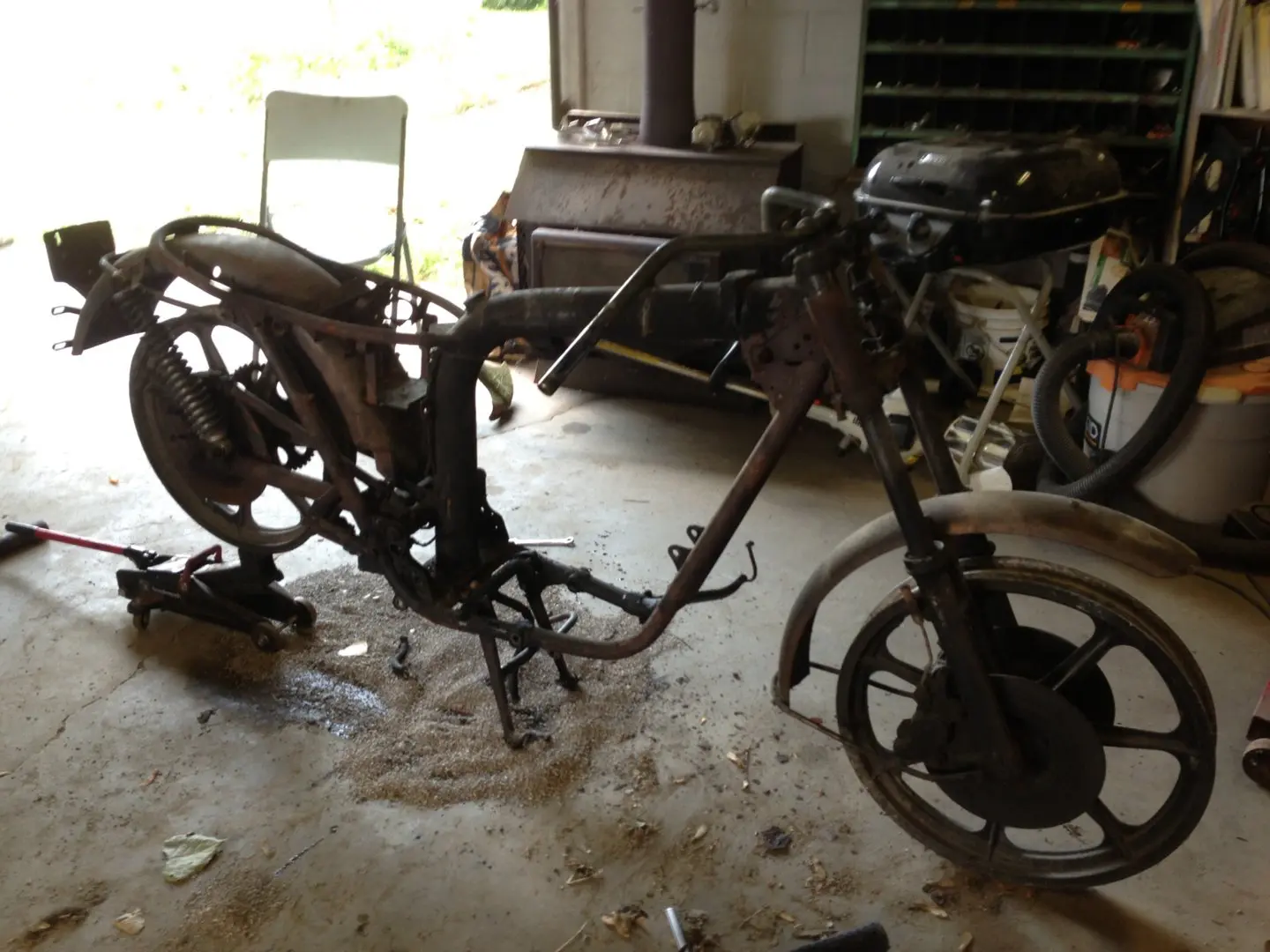
The opportunity to acquire a purportedly “complete motorcycle basket case” vintage bike project arises, and with it comes dreams of the finished project. The allure of seven tubs of parts, an engine in a complete state of disassembly, a pair of wheels, a fork and a bare frame can be too much to resist. I have personally talked myself into buying several of these neglected collections of parts with the notion that the finished project will be a valuable collectible motorcycle when completed.
No title, no problem…I’ll go through the process of acquiring one through the state Division of Motor Vehicles. After all, the $600 Triumph 650 will be worth $8000 when I’m done, and I tell my wife I can sell it for twice my investment. Well, let me share some of my experiences with British motorcycle basket cases.
For the experienced restorer, a basket case can be a worthwhile project, as the inventory of parts can be quickly ascertained, and the costs of the missing, worn out, and incompatible parts can be quickly deducted from the final value of the finished motorcycle, leading to a potential negotiation on the selling price of the basket case. Occasionally, there are extra parts included in the tubs of parts that don’t belong to the actual model or model year of the disassembled motorcycle being sold, and if you’re lucky, they may have some resale value to help fund the potential project.
My second attempt at recommissioning a basket case was a 1970 BSA A50 (not a particularly desirable model) that I purchased for $500. In the pile of parts was a set of original A65F Firebird exhaust pipes, front mudguard, and rare left-hand side panel, all specific to the 1969-1970 A65F model years. The resale of those parts exceeded the initial purchase of the (now free) basket case A50. I got lucky with that one, but it was not without the normal pitfalls that occur when undertaking the restoration process. This article is more intended to help guide the less experienced restorer who may be considering taking on a basket case.
Let’s think about the history of the basket case motorcycle and how it got to the state of disassembly. Perhaps a running motorcycle was broken down to the bare frame because a well-intentioned owner desired to improve the motorcycle by replacing all of the worn-out assemblies and refinishing the tinwork. Maybe someone was going to customize the motorcycle to “make it his/her own”. Perhaps a crash occurred and the frame was damaged, requiring repair or replacement.
The reasons are many, but above all- the motorcycle was never reassembled and now is in a hundred bits in boxes and zip-lock bags. Why was this, was it the realization that old motorcycles are more complicated than meets the eye? Perhaps the cost of the replacement parts exceeded the expectations of the builder midway through the recommissioning process, resulting in an unfinished project (basket cases are often accompanied with a few new, in-the-box parts). Basket cases often turn up at estate sales. Life happens and there are many reasons why basket case projects exist.
The first course of action once the deal is struck with the seller is to source a factory parts catalog for the specific model year of the motorcycle. Once armed with a parts book, you can do an inventory to determine what is needed to reach completion, and you will have factory part numbers to use when searching suppliers and swap meets for replacement parts. Another benefit of the parts book is that every assembly on the motorcycle is broken down with exploded views that often show the correct order of assembly. This is important to the inexperienced restorer and will save a lot of time, frustration, and expense.
Once the parts are all spread out, the parts book can help you identify what parts are meant to be fitted to the make, model, and year of the bike. Any extra parts that are in the lot that don’t apply may be traded or parlayed into cash if resold. This part of the process may be very revealing, as there are basket case projects that exist where all of the parts are worn out leftover parts from a previous restoration that are now packaged together to comprise the “95% complete basket case”.
Hopefully this would have been spotted before the purchase, but I’ve personally bought a couple of baskets that were mostly junk and didn’t curb my enthusiasm prior to handing over the cash to the seller, only to find out later that I was never going to turn a profit when the enterprise was completely finished. You win some and some you don’t.
TItles for a Motorcycle Basket Case
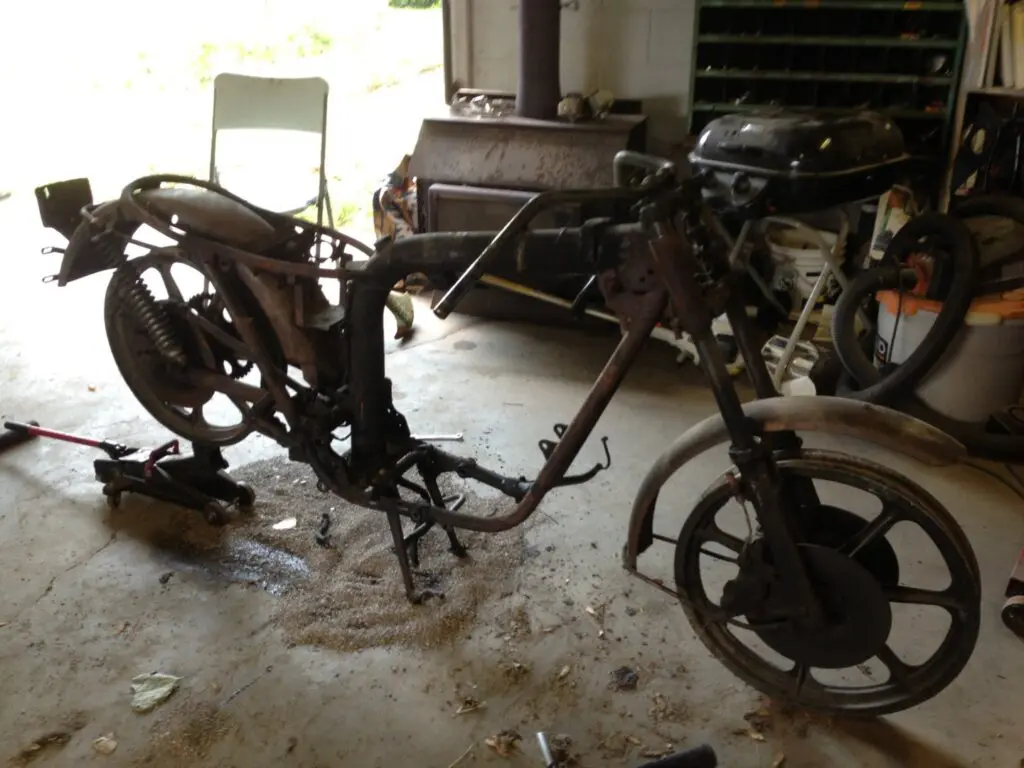
My best suggestion is to look for a “roller”, that is, a chassis with wheels attached that can be moved around. Rollers are often presented with the engine out of the frame, which is a clue the previous owner intended to overhaul the engine, but reality set in and he/she gave up on the project. The motorcycle is no longer wanted, is in the way, is a liability, and to the seller represents a bad memory. This type of scenario often yields the best project opportunity for the first-time restorer, especially when it is accompanied with a title in the seller’s name.
I mentioned titles earlier and have to bring this up as part of the process. The process of titling the motorcycle can vary from state to state, with varying levels of difficulty. Most states title the frame, which means the VIN numbers on the frame must match the numbers on the title…exactly. If the title is from another state, there exists the possibility that a title will not be issued until the state patrol (or other agency) conducts an inspection verifying the motorcycle is roadworthy.
Then there is always the possibility you have purchased a basket case that was reported stolen years ago and now you have a real headache. The cautious course of action is to try to get the seller to divulge the frame and engine numbers before you even show up to view the project so you can contact the appropriate agencies to verify its status.
If the seller is unwilling to share pictures of the frame and engine numbers (along with the title if there is one), run away from the deal, as they may be obfuscating something such as tampered VIN numbers, etc. A clean and current title is usually worth $500, so if there is no title, or one that presents itself as untoward, you can expect to negotiate the price downward before striking a deal. It’s folly to fall in love with something that can’t love you back (like a machine), so if there are any signs of dishonesty from the seller, you may want to keep looking for another project.
So, to summarize:
- Determine title status prior to purchasing a basket case project
- Once the deal is made, source a parts catalog and workshop manual
- Organize the parts and assemblies to determine the scope of the recommissioning or restoration
- Determine if specialists are available for machining, welding, and painting
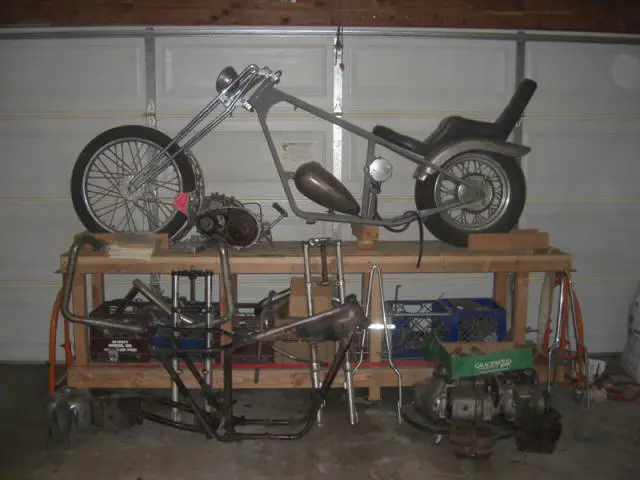
- If you plan to buy a basket for a chopper project, then look for one that has already been altered…there are lots of them out there, but remember the importance of a useable title
The mantra of “spend more to get more” applies with purchasing a basket case. A frame, matching engine, and title are a good start, but if everything else is missing the cost of sourcing the remainder of the parts will be enormous. This is why I like rollers that come with boxes of parts. Thanks for reading my article and allowing me to share my experiences.