

Shop genuine Boyer Bransden electronic ignition kits for classic Triumph, Norton and BSA motorcycles at The Bonneville Shop. Our range covers selected singles, twins and triples, along with Power Box regulator/rectifiers, a replacement MKIV ignition box, a dual-output coil and a coil heatsink.
Boyer Bransden Electronics has built electronic ignitions for British motorcycles since 1969, and its systems are hand built in the UK.
Before ordering, check each listing for its engine type, original ignition layout, voltage and coil requirements.

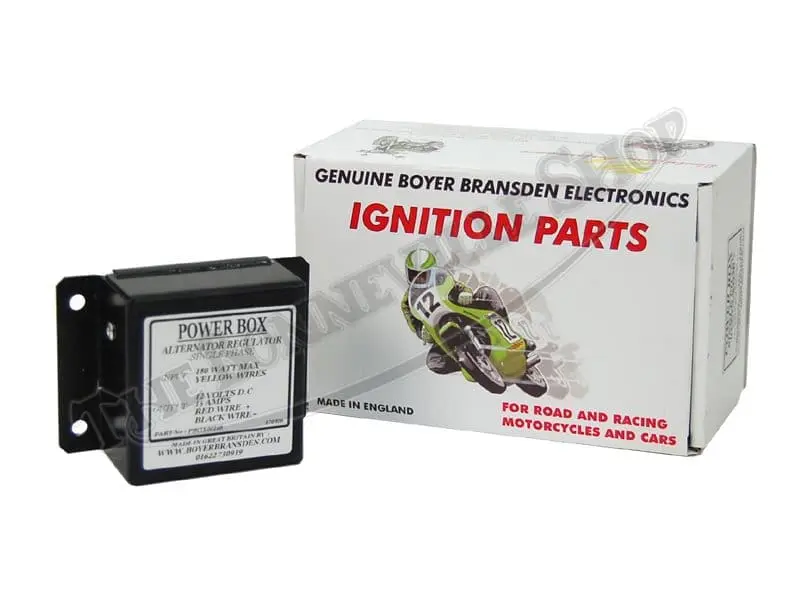
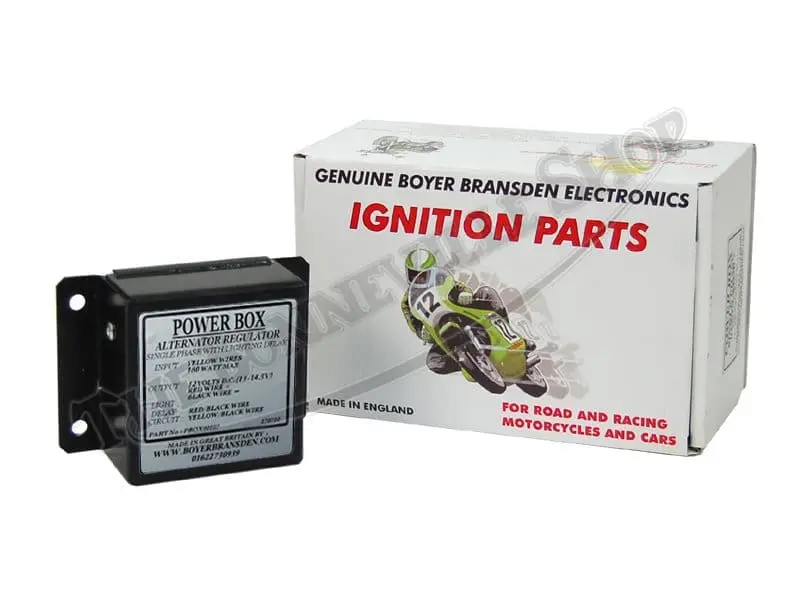



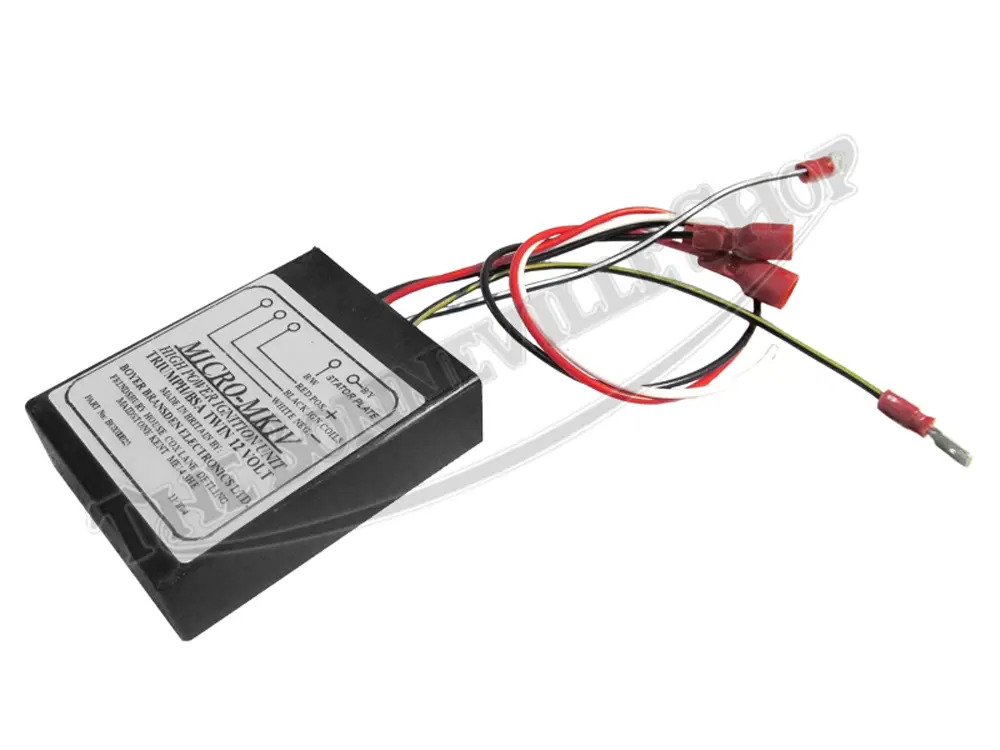

Table of Contents
About Boyer Bransden
According to Boyer Bransden’s company history, Ernie Bransden designed and patented a miniature electronic ignition in 1969, at the age of 25. The first commercial unit was made that year for Boyer of Bromley, a well-known motorcycle dealer whose Triumph race team was having trouble with contact-breaker points. That partnership gave the company its name. By the time Lucas launched its “Rita” electronic ignition in 1973, Boyer-Bransden was already making its Mark II and had sold more than 2,000 systems.
Companies House shows Boyer-Bransden Electronics Limited incorporated on 15 December 1972. Its registered office is Frindsbury House, Cox Street, Detling, near Maidstone in Kent. Boyer Bransden says it has been in constant production ever since and that every system is hand built in the UK. It sells through more than 50 distributors in 16 countries.
To compare Boyer with other electronic ignitions, see our Tri-Spark, Sparx and Electrex World brand pages, or our full range of electronic ignitions.
How Electronic Ignition Replaces Contact-Breaker Points
Contact-breaker points are a mechanical switch. They wear, they need regular gap and timing adjustment, and the arcing at each spark gradually burns the contacts. A Boyer Bransden conversion puts a magnetic rotor and pickup plate where the points and mechanical advance unit used to be, and a sealed electronic box does the switching.
Boyer says electronic ignition helps an engine start more easily, run more smoothly, use less fuel and produce lower emissions. It can also cure the “fragile” electrics many classic bikes suffer from, which are easily upset by vibration and damp (Boyer Bransden). Its analogue MKIII units have been replaced by improved MKIV versions, which keep the timing more stable when starting on a low or fluctuating battery voltage. MKIV units are fully interchangeable with earlier MK3 and MK1a units (Boyer Bransden MKIV).
Electronic ignition doesn’t fix the rest of the electrical system. You still need sound wiring, good earths, the right coils and correctly set timing. Browse Triumph electrical, Norton electrical, BSA electrical and British wiring for supporting parts.
Boyer Ignition Kits for Triumph and BSA Twins
- The Boyer Bransden MKIV electronic ignition for Triumph and BSA twins — TBS-3576 replaces the points plate and mechanical advance on side-points twins. It’s made in the UK and comes with installation instructions.
- For optimum spark, fit either two 6-volt coils, such as our Lucas-type 40mm 6V ignition coils — 45275 T, or a single Boyer 12V dual-lead coil — TBS-3586.
Boyer makes its standard Triumph/BSA twin MKIV kit for 12-volt bikes. It makes a separate 6-volt version for dynamo-charged machines (Boyer Bransden MKIV). Twins with an 18D2 distributor need Boyer’s Micro Power distributor-twin kit, which requires modification to fit (Boyer Bransden FAQ).
Boyer Ignition for Norton Atlas and Commando
- The Boyer Bransden electronic ignition for Norton Atlas and Commando twins — TBS-3575 is listed for Atlas and Commando 750 and 850 models. We recommend pairing it with 6-volt coils for optimum spark.
Boyer lists its Norton Atlas/Commando MKIV kit as a 12-volt system (Boyer Bransden MKIV). See Norton Commando parts for related components.
Boyer Ignition for Triumph and BSA Triples
- The Boyer Bransden electronic ignition for Triumph and BSA triples — TBS-3577 is listed for the Trident T150, T150V and T160, the BSA Rocket 3 (A75 and A75RV) and the X75 Hurricane.
- For best spark, wire it as described in Boyer’s instructions with a set of three 4-volt coils for Boyer systems — TBS-0028.
Boyer Ignition for Triumph and BSA Singles
Singles come in two ignition layouts, and each needs a different kit:
- Side-points singles: The Boyer electronic ignition for Triumph and BSA singles (Victor, B50, TR25W) — TBS-3578 replaces the points on unit-construction four-stroke singles with timing-side points.
- Distributor singles: The Boyer 12V electronic ignition kit for Triumph/BSA distributor singles — TBS-3549 comes with a new pickup plate and rotor, ignition module, wiring, connectors and heat-shrink tubing. Fit a 12-volt coil with it.
Boyer’s distributor-single kit is designed for bikes converted to 12-volt positive earth, with or without a battery. A Power Box is the usual way to make that conversion (Boyer Bransden instruction sheets). Our 6-volt to 12-volt conversion guide explains the steps.
Boyer Power Box Regulator/Rectifiers
A Boyer Power Box is part of the charging system, not the ignition. It replaces the original rectifier and Zener diode with a single self-regulating unit. Its built-in capacitor lets the bike run with or without a battery (Boyer Bransden Power Box).
- The Boyer Power Box regulator/rectifier and battery eliminator — PBOX00108 (TBS-3572A) is the standard 12-volt single-phase unit.
- The Boyer Power Box with lighting delay — PBOX00107 (TBS-3572) won’t let the lights come on until the engine has started. That suits minimalist builds with no separate lighting switch.
Boyer says single-phase Power Boxes suit most pre-1975 British bikes with two- or three-wire permanent-magnet alternators, and they handle up to 200 watts. They are not compatible with five-wire brush-and-slip-ring alternators (Boyer Bransden Power Box). To run without a battery, the alternator and rotor need to be in good condition. For other options, see our regulator/rectifiers, including Podtronics and Tympanium units.
Replacement Boyer Parts: Black Box, Coil and Heatsink
When a Boyer ignition fails after years of service, the electronic control box is usually the cause. You can replace it without changing the pickup plate.
- The Boyer Bransden MKIV replacement black box for Triumph and BSA twins — TBS-3576 A also upgrades an existing MKIII installation to MKIV spec. It works on Norton twins too, if you extend the wiring.
- The Boyer 12V dual-lead coil — TBS-3586 is made in the UK. It’s listed at 4.2–4.6 ohms primary and 12.5–13.5k ohms secondary resistance, with plug leads about 18 inches long. It suits twin-cylinder bikes with Boyer, Tri-Spark, Pazon or Sparx electronic ignition.
- The Boyer heatsink for dual-output coils — TBS-19-1104 is a UK-made kit for Boyer coils COIL00004 and COIL00012.
For more coils, browse our ignition coils and Lucas electrical pages.
Fitting and Troubleshooting a Boyer System
- Find your factory part numbers. A Triumph parts book, Norton parts book or BSA parts book will show the original ignition layout.
- Check what previous owners changed. Many classic bikes have already been converted to 12 volts, negative earth or a different ignition.
- Match the coils to the system. Micro Power coils are only for Micro Power units. MKIV and Micro Digital units are designed for contact-breaker-type coils (Boyer Bransden FAQ).
- Use the right plug caps and HT leads. Boyer prefers copper-core HT leads with 5,000-ohm suppressed plug caps. They are recommended for MKIV and required for Micro Digital and Micro Power (Boyer Bransden FAQ).
- Set the timing on the correct shaft. Boyer notes that camshaft degrees are half of crankshaft degrees. A 650 Triumph timed at 38 degrees full advance at the crankshaft is set at 19 degrees on the camshaft (Boyer Bransden fault finding).
Boyer publishes fitting instruction sheets for each kit and a fault-finding guide. For workshop procedures, see our Triumph manuals, Norton manuals and BSA manuals, plus the Bonneville Shop Tech Blog. If you’re not sure which kit you need, contact us before ordering. Electrical components can’t be returned; see Shipping & Returns.
Boyer Bransden FAQs
Who makes Boyer Bransden ignitions?
Boyer-Bransden Electronics Limited, a British company based in Detling, near Maidstone, Kent, makes them. Ernie Bransden designed the original ignition in 1969, and the company was incorporated in 1972 (Boyer Bransden; Companies House).
Are Boyer Bransden ignitions made in the UK?
Yes. Boyer Bransden says all its systems are carefully hand built in the UK (Boyer Bransden).
Why is it called Boyer Bransden?
Boyer Bransden made its first commercial ignition in 1969 for Boyer of Bromley. That dealership’s Triumph race team had been having trouble with contact-breaker points (Boyer Bransden). The name combines the dealer’s name with Ernie Bransden’s surname.
Which Boyer Bransden kit fits my motorcycle?
It depends on the engine type and the original ignition layout. In our range, TBS-3576 fits Triumph/BSA twins, TBS-3575 fits the Norton Atlas and Commando, TBS-3577 fits the Triumph/BSA triples, TBS-3578 fits side-points singles and TBS-3549 fits distributor singles. Check the listing and your parts book before ordering.
Which coils should I use with a Boyer ignition?
For Triumph and BSA twins, use either two 6-volt coils or one 12-volt dual-lead coil. For Norton Atlas and Commando, we recommend 6-volt coils. For the Triumph and BSA triples, use three 4-volt coils. Never use a Micro Power coil with an MKIV or Micro Digital unit, because the high current can damage both the unit and the coil (Boyer Bransden FAQ).
Does a Boyer ignition need a 12-volt electrical system?
Most Boyer MKIV kits are 12-volt systems, including the twin, Norton and distributor-single kits we stock. Boyer makes separate 6-volt versions for dynamo-equipped bikes (Boyer Bransden MKIV). Many owners fit a Power Box as part of a 6-volt to 12-volt conversion. Our conversion guide explains how.
What does a Boyer Power Box do?
A Power Box is a self-regulating rectifier with a built-in capacitor. It connects directly to a permanent-magnet alternator and puts out about 14.5 volts under load, which is right for charging a 12-volt battery or running the electrics without one (Boyer Bransden Power Box).
What’s the difference between PBOX00108 and PBOX00107?
Both are 12-volt single-phase Power Boxes. PBOX00107 adds a lighting-delay circuit that keeps the lights off until the engine has started. PBOX00108 is the standard version without it (Boyer Bransden Power Box).
Can I run my British motorcycle without a battery?
Yes, with a Power Box and a charging system in good health. When running without a battery, Boyer says no fuse is needed and shorting the output to stop the engine won’t damage the unit (Boyer Bransden Power Box). Old, original alternators and rotors may not put out enough power to run battery-less with electronic ignition.
How can I tell which Boyer system is on my bike?
Look at the color of the ignition box. MKIII and MKIV boxes are black, Micro Digital boxes are red, and current Micro Power boxes are blue (early Micro Power units were red). Micro Power systems also use miniature specialist coils (Boyer Bransden FAQ).
Can I replace only the Boyer black box?
Yes. The TBS-3576 A replacement MKIV box fits Triumph and BSA twins, and Norton twins if you extend the wiring. Boyer says MKIV units are fully interchangeable with earlier MK3 and MK1a units (Boyer Bransden MKIV).
Do I need suppressed plug caps with a Boyer ignition?
Boyer recommends copper-core HT leads with 5,000-ohm suppressed plug caps. MKIV systems will run without suppression, but Micro Digital and Micro Power units must have suppressed caps. Using non-suppressed caps on those units has caused permanent damage (Boyer Bransden FAQ).
What warranty comes with Boyer Bransden products?
Boyer Bransden gives a five-year warranty on ignition units and one year on coils. The original labels must still be on the parts, and you’ll need proof of purchase (Boyer Bransden FAQ). The Bonneville Shop doesn’t accept returns on electrical components, so please ask any fitment questions before you order.
My Boyer ignition sparks but the engine won’t start. What should I check?
Boyer’s fault-finding guide suggests checking that the stator wire colors haven’t been swapped in the loom, which retards the timing by more than 50 degrees. On digital systems, check that suppressed plug caps are fitted, and confirm the timing was set in camshaft degrees rather than crankshaft degrees. Boyer also notes the ignition won’t fire if you turn the engine by hand below about 200 rpm.