

Table of Contents
**Disclaimer: This information has been compiled by a resource independent of The Bonneville Shop. Please conduct your own research and verify that the information is correct before utilizing any of the information in this post.**
Also, check out our other tech blogs:
- Cam Timing Notes – Part II – The Bonneville Shop
- The Brain of Your Triumph B Range Engine- the Camshaft – The Bonneville Shop
Note that cam lift numbers are sometimes specified at the valve, and sometimes at the lifter (follower/tappet), which will be the same as the lobe height. Triumph rockers generally (as far as I know) have around a 1:1.1 ratio. This means that the valve lift does not equal the lobe height – lift at the valve will be higher than the lift at the lifter.
Cam timing is sometimes quoted at 0.020″ of valve clearance, sometimes with 0.040″ of valve clearance, and sometimes at 0.050″. 0.020 is the older way, but 0.040 is used because that’s almost exactly 1mm, and modern (IE metric) cam timings are specified with 1mm of clearance.
Triumph part number conversion:
Factory cam timing numbers
These numbers are from various shop manuals (Triumph, Haynes, Clymer, etc), which most likely originally come from the Triumph manuals. I think the lift numbers quoted are measured at the tappet (IE the cam lobe height), but it’s not explicitly stated.
| intake | exhaust | |||||||
| open | closes | opens | closes | lift | measured clearance | tappet radius | ||
| btdc | abdc | bbdc | atdc | intake | exhaust | |||
| 650cc | 34 | 55 | 55 | 34 | 0.002 | |||
| 6T DU.101 on | 25 | 52 | 60 | 17 | 0.305 | 0.305 | 0.020 | |
| TR6 DU.101 to DU.44393 | 34 | 55 | 48 | 27 | 0.314 | 0.296 | 0.020 | |
| T120 DU.101 to DU.24874 | 34 | 55 | 48 | 27 | 0.314 | 0.296 | 0.020 | 0.750 (STD) |
| T120 DU.24875 to DU.44393 | 34 | 55 | 55 | 34 | 0.314 | 0.314 | 0.020 | |
| T100S | 34 | 55 | 48 | 27 | 0.296 | 0.020 | 0.750 (STD) | |
| T100T | 40 | 52 | 61 | 31 | 0.314 | 0.314 | 0.020 | 1.125 (R) |
| 5TA to H.49833 | 34 | 44 | 48 | 27 | 0.020 | |||
| TR5T | 34 | 55 | 48 | 27 | 0.020 | 0.750 (STD) | ||
| T100R | 40 | 52 | 61 | 31 | 0.020 | 1.125 (R) | ||
| TRIUMPH 750 SHORT ROD | 26.5 | 69.5 | 61.5 | 35.5 | 0.350 | 0.350 | 0.020 | 1.125 ? What Cam ? |
| TRIUMPH 750 INTAKE (T-75) | 40 | 74 | 0.345 | 0.020 | 1.125 Matches M20416 T140E intake | |||
| JOMO 15 | 43 | 74 | 74 | 43 | 0.355 | 0.355 | 0.020 | 1.125 (R) |
Notes on the legendary Triumph E3134 “Q” cam
- The E3134 cam wasn’t (always) a specific cam, it was a cam profile that was used on many cams for many years. There may have been a cam with the part number E3134, but there were many other cams that used the E3134 profile.
- To make things more confusing, there were two E3134 cams – Tricor and Factory. The Tricor profile (34/55 55/34) is the most common.
- The E3134 may have been the hot thing many years ago, but it’s no longer considered a high performance profile.
This is the E3134 profile:
| intake | exhaust | |||||||
| open | closes | opens | closes | lift | measured clearance | tappet radius | ||
| btdc | abdc | bbdc | atdc | intake | exhaust | |||
| Tricor “Q” E3134 | 34 | 55 | 55 | 34 | 0.314 | 0.314 | 0.020 | 1.125 (R) |
| Factory “Q” E3134 | 34 | 58 | 58 | 34 | 0.310 | 0.310 | 0.020 | 1.124 (R) |
Group 1 – High Performance – E3134 “Q” Cam Form
- Intake opens: 34 BTDC – Intake closes: 55 ABDC
- Exhaust opens: 55 BBDC – Exhaust closes: 34 ATDC
| Part# | Code | Casting # | Intake/Exhaust |
|---|---|---|---|
| E3134 | E3134 | ||
| E4819 | X | E3134 | Inlet |
| E5047 | YCP | E5048 | Exhaust |
| E5162 | XCP | E4602 | Inlet |
| E10040 | XN | E10040 | Inlet |
| E10041 | YN | E10041 | Exhaust |
| E4038 | SG | E3838 | Inlet |
| E4039 | E3838 | Exhaust | |
| E4678 | E4679 | Inlet | |
| E5044 | YCP | E5045 | Exhaust |
| E5047 | Y* | Exhaust | |
| E5163 | CP | E4679 | Inlet |
| E6965 | Y | E6642 | Exhaust |
| E10043 | N | E10043 | Inlet |
| E10047 | E10050 | Exhaust | |
| E11063 | N | 71-0040 | Inlet |
| E11064 | N | 71-0043 | Inlet |
| E9983 | YN | 71-9986 | Exhaust |
| E9984 | YN | 70-9987 | Exhaust |
| E9989 | YN | 70-9990 | Exhaust |
1. Running clearance .002 in. intake and .004″ exhaust.
2. Take readings at .020 in. follower lift with “std” radius (3/4 in.) followers
3. Lobe Center 100.5 °
4. Duration 269 °
5. Lift .314 in.
Group 2 – High speed touring – E3325 Cam Form
- IO 27 BTDC – IC 48 ABDC – EO 48 – BBDC – EC 27 ATDC Inlet or Exhaust
| Part # | Code | Casting # | Intake/Exhaust |
|---|---|---|---|
| E3325 | E3325 | ||
| E4818 | X | E4997 | Inlet |
| E4848 | Y | E4560 | Exhaust |
| E4855 | Y | E4561 | Exhaust |
| E4931 | Inlet | ||
| E4022 | SG | E3838 | Inlet |
| E4023 | E4679 | Exhaust | |
| E4786 | Y | E4679 | Exhaust |
| E10046 | YN | E10049 | Exhaust |
1. Running clearance .002 in. intake and .004″ exhaust.
2. Take readings at .020″ follower lift with “std” radius (3/4 in.) followers
3. Lobe center 100.5°
4. duration 255°
5. Lift .296 in.
Group 3 – Ramp cam form (standard) – Quieting ramps
- Intake opens: 26.5 BTDC – Intake closes: 69.5 ABDC
- Exhaust opens: 61.5 BBDC – Exhaust closes: 35.5 ATDC
| Part # | Code | Casting # | Intake/Exhaust |
|---|---|---|---|
| E3275 | E3265 | ||
| E3838 | SG | E3838 | Inlet |
| E3839 | E3838 | Exhaust | |
| E5341 | Y | E5342 | Exhaust |
1. Running clearance .010 in Intake and Exhaust.
2. Take readings at .020″ follower lift using “standard” followers.
Group 4 – Modified ramp form (racing)
- Thruxton Bonneville
| Part # | Code | Casting # | Timing |
|---|---|---|---|
| E4220 | E4220 | Valve lift at TDC with nil clearance 0.195/0.175″ Intake | |
| E6267 | E4220 | Valve lift at TDC with nil clearance 0.205/0.215″ Intake | |
| E6147 | Y | E6146 | Valve lift at TDC with nil clearance 0.165/0.175″ Exhaust |
1. Running clearance E4220 .008 in. E6267 & E6147 .013 in.
2. Valve timing taken in inches of VALVE lift at T.D.C. with valves set at nil clearance for checking.
3. E6267 and E6147 must be used with 3″ radius cam followers and special guide blocks.
Key to Codes:
- X = Breather
- Y = Contact breaker
- CP = Copper plated
- SG = Spiral gear (distributor drive)
- n = nitrited
“Specs for Stock Triumph 750 Short Rod”
- Intake: 26.5* – 69.5* 111.5* lobe center
- Exhaust: 61.5* – 35.5* 103.0* lobe center
- measured @ .020″ tappet lift
- running clearance .010″ intake and exhaust
- valve lift: .350″ 278* duration
Random cam numbers I’ve run across:
- M20416 – 71-288? casting – 750 intake
- M20360 – 750 exhaust
- E5048 – T120 exhuast – E3134 profile – use R followers
- E3059R – “R” follower
- E1485 in/ex 1938/9 5T
- E3275 in/ex 1953-8 5T
- E3325 in/ex 1955-8 TR5
- E4819 – Bonneville E3134 profile intake
- E4855 – Bonneville E3134 profile exhaust.
- 70-7016 – T140 intake
- 70-7017 – T140 exhaust cam
- 70-9990 – T120 exhaust, mate to 71-1063?
- 70-9986 – 1970 T100C exhaust cam
- 70-9989 – 67-72 T120 exhuast cam
- 70-9989 – 650 Exhuast cam
- 70-9989 – T120 exhaust cam late unit
- 70-9989 – Exhuast cam, half race
- 71-0040 – Cam, intake
- 71-0041 – Cam, exhaust
- 71-0043 – Forging blank for 71-1064, 70-9986
- 71-0046 – Cam, T100, exhuast
- 71-0046 – T100C exhaust cam
- 71-0049 – T100 ex cam 68 on
- 71-1063 – T120 intake – Nitrided E3134 profile – use R followers
- 71-1063 – Cam, ’70 and later
- 71-1063 – 70-72 T120 intake cam
- 71-1064 – 1970 T100C intake cam
- 71-3011 – T140 intake – up to 1975.
- 71-3012 – T140 exhaust – up to 1975.
- 71-7016 – T140 intake cam
- 71-7017R – T140 spitfire exhaust cam
- 71-7182 – T140 exhaust cam
- 70-3059 – ‘S’ cam follower
- 70-3059R – ‘R’ cam follower
- 70-8801 – cam follower
- 71-7008 – cam follower
- 70-8801 – 650/750 exhaust follower oil feed
- 71-2297 – B50 cam
Cam forging blank numbers
These are not cam numbers, they are the part number for a blank that a cam profile is ground onto. A single blank will often be used for a number of different cam grinds, so this number doesn’t actually tell you what cam you have. The forging number should have raised numbers, the cam grind number should be stamped in. Either number is sometimes omitted.
- 71-0040 – Forging blank for 71-1063
- 71-0042 – Forging blank for 71-9990
- 71-2887 – Forging blank for 71-3011
- 71-0042 – Forging blank for 71-3012
- 71-3012 – Forging blank for 71-3012 (really)
Someone recommends “put a T140 inlet in the exhaust using a modified rev counter nut/drive to spin a one off Boyer rotor. FWIW, I clocked up
the cam and it’s almost identical to Nourish’s Z cam, so I used his timings of 102 degrees.”
TRICOR “Q” intake cam is also named E3134-E4819:
- intake 34-55 deg,
- exhaust 55-34 deg
- cam lift .314″
- duration 269
- lobe center 100.5 deg
vs
FACTORY “Q” E3134-E4819:
- intake 34-58 deg,
- exhaust 58-34 deg
- cam lift .310″
- duration 269
- lobe center 102.5 deg
Megacycle cam grinds
Triumph 650/750 twins:
| Cam Number | Lobe Height | Duration at .020″ | Lobe Centers | Tappet Style | Description and Application | Intake: open/close Exhaust: open/close | Running Clearance |
|---|---|---|---|---|---|---|---|
| 510-05 | .348″ .348″ | 282 282 | 100 102 | “R” | Best for low-end and some mid-range increase. Street / road performance 2500 R.P.M. to 7000 R.P.M. Should clear pistons. Check clearance. Uses stock springs. | 41 btc/61 abc 63 bbc/39 atc | .010″ .010″ |
| 510-15 | .355″ .355″ | 297 297 | 105.5 105.5 | “R” | The legendary Kenny Harman #15 grind. (Also known as JOMO 15). TT, flat track, all around use. Must use modified springs. | 43 btc/74 abc 74 bbc/43 atc | .007″ .009″ |
| 510-xl | .401″ .401″ | 308 308 | 102 106 | “STD” only | Reproduction of Sifton 460. Racing use. Mid-range to top-end power. | 52 btc/76 abc 80 bbc/48 atc | .008″ .010″ |
| 510-65 | .355″ .355″ TDC lift | 292 295 | 101 104.5 .163″ in .150″ ex | “R” | For 650 or 750. Best all around street and road cam. Broad power band, mid-range and top-end. TT style performance. Use modified springs. (Recommended by Motorcyclist Magazine) | 45 btc/67 abc 72 bbc/43 atc | .010″ .010″ |
| 510-75 | .400″ .400″ TDC lift | 326 326 | 102 105 102LC=.159″ 105LC=.146″ | “STD” only | Racing use only. Must remove material from tappet guide blocks to install this cam. High R.P.M. power. Must use racing springs and pistons. Check clearance. | 61 btc/85 abc 88 bbc/58 atc | .008″ .008″ |
| 510-x2 | .375″ .375″ | 296.5 296.5 | 103 105 | “R” | New race profile. Best all around road-race. Best peak performance. May need to trim flywheel clearance. Use racing pistons and springs. TDC lift in = .174″ @ 1.1 rocker ratio/with lash | ||
| Base circle diameter=.812″ | ex=.153″ | ||||||
| 510-95 | .400″ .400″ | 340 340 | 108 108 | “STD” only | Full race only. All racing components required. High R.P.M. drag race, grass track, competition. | 62 btc/98 abc 98 bbc/62 atc | .008″-.014″ .008″-.014″ |
| Stock 650 | .322″ .322″ | 272 272 | .322″ 278 .322″ 278 | Stock for your reference. 750 short rod |
Triumph 500 twins:
All cams listed below will work with “R” or “STD” tappets
| Cam Number | Lobe Height | Duration at .020″ | Lobe Centers | Description and Application | Intake: open/close Exhaust: open/close | Running Clearance |
|---|---|---|---|---|---|---|
| 512-05 | .348″ .348″ | 282 282 | 100 102 | Designed for stock pistons and springs. Good throttle response/all around performance. | 41 btc/61 abc 63 bbc/39 atc | .010″ .010″ |
| 512-65 | .355″ .355″ | 292 295 | 101 104.5 | Best all around street/road race profile. | 42 btc/67 abc 72 bbc/43 atc | .010″ .010″ |
| 512-x5 | .293″ | 296.5 | 1938 Triumph 500 Twin stock reproduction. | |||
| 512-x8 | .375″ .375″ | 296.5 296.5 | 103 on “R” 105 on “R” | Best competition road-race profile. Maximum peak horsepower and throttle response. Must use racing pistons and valve springs. Trim flywheel for clearance. | 44.5 btc/71 abc 73.5 bbc43 atc | .008″ .010″ |
Triumph and BSA triples:
| Cam Number | Lobe Height | Duration at .040″ | Lobe Centers | Tappet Style | Description and Application | Intake: open/close Exhaust: open/close | Running Clearance |
|---|---|---|---|---|---|---|---|
| 511-05 | .345″ .345″ | 282 282 | 98 102 | “STD” | Best all around profile, road and touring. Use modified pistons and springs. This was the factory road race profile used by Dick Mann at Daytona. Smooth power band. | 43 btc/59 abc 63 bbc/39 atc | .005″ .007″ |
| 511-x5 | .375″ .375″ | 287 287 | 104.5 107.5 | “STD” | Road race profile. Strong mid-range, top-end. All out racing. Use modified pistons and valve springs. | 39 btc/68 abc 71 bbc/36 atc | .008″ .010″ |
| 511-35 | .346″ .346″ | 268 268 | 104 104 | “STD” | Short road race where throttle response is most important. Less top-end than the 511-00. Very strong mid-range. | 30 btc/58 abc 58 bbc/30 atc | .008″ .010″ |
| 511-75 | .400″ .400″ | 274 274 | 108 108 | “STD” | Full race. Must trim tappet guide blocks. High R.P.M. race application. Race components. | 29 btc/65 abc 65 bbc/29 atc | .008″ .010″ |
| 511-95 | .400″ .400″ | 288 288 | 100 100 | Special application race profile. | 44 btc/64 abc 64 bbc/44 atc | ||
| Stock | .328″ | 262 | For reference. |
Johnson Cam Grinds
T100R Daytona
| LIFT | CENTER | LASH | TAPPET | DUR’N | OPEN | CLOSE | AT | |
| INTAKE | R | 272 | 40 | 52 | .020 | |||
| EXHAUST | R | 272 | 61 | 31 | .020 |
T120 “E3134”
| LIFT | CENTER | LASH | TAPPET | DUR’N | OPEN | CLOSE | AT | |
| INTAKE | .314 | 269 | 34 | 55 | .020 | |||
| EXHAUST | 269 | 55 | 34 | .020 |
Triumph 750 short rod
| LIFT | CENTER | LASH | TAPPET | DUR’N | OPEN | CLOSE | AT | |
| INTAKE | .350 | 111.5 | .010 | 278 | 26.5 | 69.5 | .020 | |
| EXHAUST | .350 | 103 | .010 | 278 | 61.5 | 35.5 | 0.020 |
Q cam
- Factory speed kit grind for 500’s of the 50’s, also used in the 650 TT
- Specials of the 60’s.
| LIFT | CENTER | LASH | TAPPET | DUR’N | OPEN | CLOSE | AT | |
| INTAKE | .316 | 105 | .002 | R | 271 | 31 | 60 | .020 |
| INTAKE | .316 | 105 | .002 | R | 251 | 21 | 50 | .040 |
| EXHAUST | .316 | 105 | .004 | R | 271 | 61 | 30 | .020 |
| EXHAUST | .316 | 105 | .004 | R | 251 | 51 | 20 | .040 |
Jomo TT Cam
A little more duration than the Q cam, gives a little more top end power.
| LIFT | CENTER | LASH | TAPPET | DUR’N | OPEN | CLOSE | AT | |
| INTAKE | .310 | 105 | .002 | R | 276 | 33 | 65 | .020 |
| INTAKE | .310 | 105 | .002 | R | 255 | 21 | 53 | .040 |
| EXHAUST | .310 | 105 | .004 | R | 276 | 62 | 35 | .020 |
| EXHAUST | .310 | 105 | .004 | R | 255 | 52 | 23 | .040 |
Harmon&Collins 7054 Cam
A little more lift than the Q cam. For more mid-range torque.
| LIFT | CENTER | LASH | TAPPET | DUR’N | OPEN | CLOSE | AT | |
| INTAKE | .326 | 105 | .002 | R | 267 | 31 | 56 | .020 |
| INTAKE | .326 | 105 | .002 | R | 246 | 20 | 46 | .040 |
| EXHAUST | .326 | 105 | .004 | R | 267 | 61 | 26 | .020 |
| EXHAUST | .326 | 105 | .004 | R | 246 | 50 | 16 | .040 |
Connely #1 Cam
Lots of torque off tight corners. Tight TT, short Motocross, not good at high rpm.
| LIFT | CENTER | LASH | TAPPET | DUR’N | OPEN | CLOSE | AT | |
| INTAKE | .353 | 105 | .002 | R | 280 | 31 | 69 | .020 |
| INTAKE | .353 | 105 | .002 | R | 261 | 21 | 59 | .040 |
| EXHAUST | .353 | 105 | .004 | R | 280 | 61 | 39 | .020 |
| EXHAUST | .353 | 105 | .004 | R | 261 | 51 | 29 | .040 |
Johnson J360/264 Cam
Johnson designed for 750 Triple Road racing, and by coincidence is a modern version of the TH6.
| LIFT | CENTER | LASH | TAPPET | DUR’N | OPEN | CLOSE | AT | |
| INTAKE | .353 | 102 | .006 | R | 305 | 51 | 73 | .020 |
| INTAKE | .353 | 102 | .006 | R | 277 | 73 | 60 | .040 |
| EXHAUST | .353 | 110 | .006 | R | 305 | 83 | 41 | .020 |
| EXHAUST | .353 | 110 | .006 | R | 277 | 69 | 29 | .040 |
Triumph T-3 Cam
Stock 750 triple cam. Has always been hard to beat and works well in 500 twins also.
| LIFT | CENTER | LASH | TAPPET | DUR’N | OPEN | CLOSE | AT | |
| INTAKE | .328 | 102 | .006 | R | 393 | 44 | 69 | .020 |
| INTAKE | .328 | 102 | .006 | R | 264 | 30 | 54 | .040 |
| EXHAUST | .328 | 105 | .008 | R | 293 | 72 | 41 | .020 |
| EXHAUST | .328 | 105 | .008 | R | 264 | 57 | 27 | .040 |
Triumph T-65 Cam
Between a Q and a Jomo 15. Good for hot street, short track, and TT in 650 and 750 twins.
| LIFT | CENTER | LASH | TAPPET | DUR’N | OPEN | CLOSE | AT | |
| INTAKE | .344 | 105 | .008 | R | 280 | 36 | 64 | .020 |
| INTAKE | .344 | 105 | .008 | R | 255 | 23 | 52 | .040 |
| EXHAUST | .344 | 105 | .010 | R | 280 | 66 | 35 | .020 |
| EXHAUST | .344 | 105 | .010 | R | 255 | 53 | 22 | .040 |
Triumph T-75 Cam
Stock 750 twin intake. Use in exhaust also, for hot street motors and racing, where endurance means more than the last HP. Good to 7000rpm with stock springs. Similar to Nourish Z.
| LIFT | CENTER | LASH | TAPPET | DUR’N | OPEN | CLOSE | AT | |
| INTAKE | .345 | 105 | .010 | S | 294 | 40 | 74 | .020 |
| INTAKE | .345 | 105 | .010 | S | 270 | 29 | 61 | .040 |
| EXHAUST | .345 | 105 | .010 | S | 294 | 71 | 44 | .020 |
| EXHAUST | .345 | 105 | .010 | S | 270 | 59 | 32 | .040 |
Jomo 15 Cam
This cam has long been considered the classic “all around” racing cam for the Triumph 650 and 750 twins.
| LIFT | CENTER | LASH | TAPPET | DUR’N | OPEN | CLOSE | AT | |
| INTAKE | .354 | 106 | .006 | R | 289 | 37 | 72 | .020 |
| INTAKE | .354 | 106 | .006 | R | 267 | 28 | 60 | .040 |
| EXHAUST | .354 | 106 | .008 | R | 289 | 69 | 39 | .020 |
| EXHAUST | .354 | 106 | .008 | R | 267 | 59 | 29 | .040 |
Sifton 390 Cam
This grind is an improved version of the Jomo 15. With less seat to seat timing the motor makes more torque, and runs “crisper” down low.
| LIFT | CENTER | LASH | TAPPET | DUR’N | OPEN | CLOSE | AT | |
| INTAKE | .352 | 105 | .008 | S | 290 | 39 | 71 | .020 |
| INTAKE | .352 | 105 | .008 | S | 267 | 28 | 58 | .040 |
| EXHAUST | .352 | 105 | .008 | S | 290 | 69 | 41 | .020 |
| EXHAUST | .352 | 105 | .008 | S | 267 | 58 | 28 | .040 |
Triumph TH6 Cam
Developed by Doug Hele for the factory 500 twin road racers of the late 60’s, also used in the 750 triples of the 70’s.
| LIFT | CENTER | LASH | TAPPET | DUR’N | OPEN | CLOSE | AT | |
| INTAKE | .350 | 105 | .006 | R | 305 | 49 | 77 | .020 |
| INTAKE | .350 | 105 | .006 | R | 274 | 33 | 61 | .040 |
| EXHAUST | .350 | 105 | .008 | R | 305 | 79 | 47 | .020 |
| EXHAUST | .350 | 105 | .008 | R | 274 | 63 | 31 | .040 |
Sifton 460 Cam
For 1/2 mile and mile flat track and real racers. NOT FOR THE FAINT OF HEART! Must trim flywheel and tappet blocks.
| LIFT | CENTER | LASH | TAPPET | DUR’N | OPEN | CLOSE | AT | |
| INTAKE | .400 | 105 | .008 | S | 306 | 49 | 77 | .020 |
| INTAKE | .400 | 105 | .008 | S | 283 | 37 | 65 | .040 |
| EXHAUST | .400 | 105 | .010 | S | 306 | 79 | 47 | .020 |
| EXHAUST | .400 | 105 | .010 | S | 283 | 67 | 35 | .040 |
Johnson J 46
Johnson Design for a smoother, modern version of the Sifton 460mcam.
This grind was developed to be easier on springs, tappets, etc.
Must trim flywheel and tappet blocks.
| LIFT | CENTER | LASH | TAPPET | DUR’N | OPEN | CLOSE | AT | |
| INTAKE | .410 | 102 | .008 | S | 303 | 50 | 73 | .020 |
| INTAKE | .410 | 102 | .008 | S | 279 | 38 | 61 | .040 |
| EXHAUST | .410 | 110 | .008 | S | 303 | 82 | 41 | .020 |
| EXHAUST | .410 | 110 | .008 | S | 279 | 70 | 29 | .040 |
Johnson J481 Cam
Johnson design drag race cam. It is not recommended for anything other than drag racing. Must trim flywheel and tappet blocks.
| LIFT | CENTER | LASH | TAPPET | DUR’N | OPEN | CLOSE | AT | |
| INTAKE | .443 | 102 | .008 | S | 316 | 57 | 79 | .020 |
| INTAKE | .443 | 102 | .008 | S | 290 | 44 | 66 | .040 |
| EXHAUST | .443 | 110 | .008 | S | 316 | 89 | 47 | .020 |
| EXHAUST | .443 | 110 | .008 | S | 290 | 76 | 35 | .040 |
Frequently Asked Questions
What is cam timing on a classic Triumph motorcycle?
Cam timing describes when the intake and exhaust valves open and close relative to crankshaft position. Classic Triumph cam specifications list these events in crankshaft degrees, together with information such as lift, duration and the checking height used to measure them. When comparing specifications, make sure the measurement conditions match. Our guide to the camshaft in your Triumph B-range engine provides additional background on this engine component.
What is the difference between cam lift and valve lift?
Cam lift is the movement produced at the cam follower or tappet, while valve lift is the movement at the valve after the rocker arm transfers that motion. They are not necessarily equal: the rocker ratio changes how much the valve moves. Before comparing Triumph camshafts, check whether each specification describes lift at the cam or at the valve. The Cam Timing Notes guide explains why this distinction matters when reading different cam tables.
Why are Triumph cam timing figures measured at .020, .040 or .050 inch?
Different cam specifications use different checking heights or checking-clearance procedures to define when an opening or closing event is recorded. A duration measured at .020 inch is therefore not directly comparable with one measured at .040 or .050 inch. Also check whether the stated measurement is taken at the tappet or valve. For example, Megacycle’s Triumph 650/750 twin specifications explicitly list duration at .020 inch, so that measurement basis must stay with the figures.
What do BTDC, ABDC, BBDC and ATDC mean in cam timing specifications?
BTDC means before top dead center; ABDC means after bottom dead center; BBDC means before bottom dead center; and ATDC means after top dead center. These abbreviations identify crankshaft position when a valve reaches the specified checking point. In a typical intake listing, “41 BTDC / 61 ABDC” means the intake opening is measured before top dead center and its closing after bottom dead center. You can see this format in Megacycle’s Triumph twin cam tables
What is the Triumph E3134 “Q” cam, and are all E3134-profile cams identical?
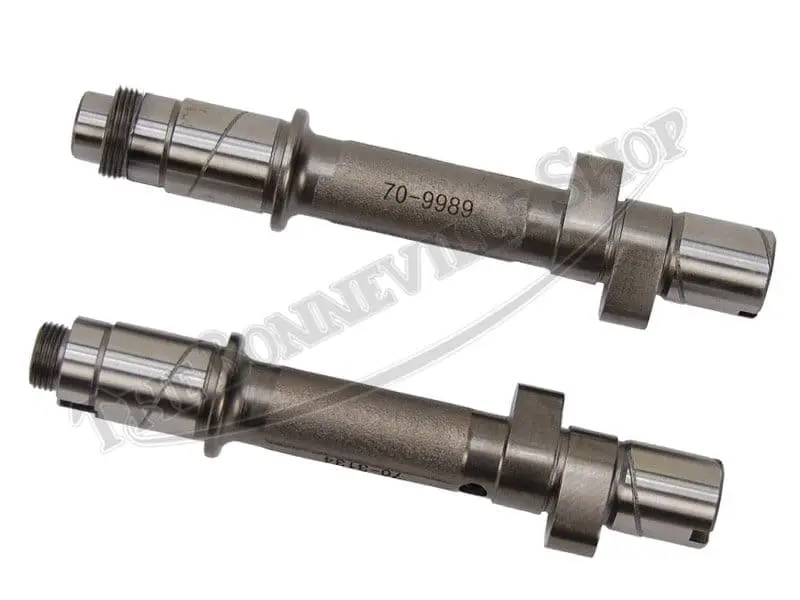
The E3134 designation is associated with a Triumph cam profile used across multiple camshaft applications, rather than identifying every camshaft’s complete fitment. The article also distinguishes Tricor and factory versions, so an E3134 reference alone does not establish one universal timing specification. Check the actual grind, application and measurement procedure before using published figures. See our E3134 cam profile notes and the 70-3134 / 70-9989 half-race camshaft set for related information.
How do I identify a Triumph camshaft from its casting or stamped numbers?
Distinguish the raised forging or casting number from the stamped cam identification. A forging number identifies the blank used to make the camshaft, and the same blank may support several different grinds. It cannot reliably identify the finished profile by itself. Compare any stamped identification with the relevant parts information and measured cam characteristics. Our Triumph cam forging-number reference explains this distinction and lists examples.
What is the difference between “R” and “STD” Triumph cam followers?
In Megacycle’s Triumph twin specifications, “R” identifies a follower with a 1⅛-inch contact-face radius, while “STD” identifies a ¾-inch radius. These describe the curvature of the working face, not the follower’s outside diameter. The specified follower type matters when interpreting cam timing and application information. Check the individual grind’s requirements rather than assuming the two types are interchangeable; the Megacycle Triumph twin reference identifies the follower style for each listed profile.
Is valve clearance the same as the checking clearance used for cam timing?
No. Running valve clearance is the adjustment specified for engine operation, while checking clearance or checking lift is part of the procedure used to measure cam timing. A cam specification may require zero checking clearance or a particular measurement height even though its running-clearance figures are different. Follow the instructions for the exact camshaft and engine, then restore the specified running clearances after checking. The Megacycle camshaft catalog illustrates these different measurement conventions.
What tools do I need to check Triumph cam timing accurately?
Accurate cam timing checks generally require a crankshaft-mounted degree wheel and a securely mounted dial indicator, used according to the cam manufacturer’s measurement procedure. The specified measuring point matters: a procedure based on tappet movement cannot automatically be replaced with one based on valve movement. Megacycle recommends degreeing cams with a degree wheel and dial indicator; see its camshaft installation guidance alongside our Cam Timing Notes—Part II.
Which camshaft is best for a classic Triumph 650 or 750 road bike?
The appropriate camshaft depends on the desired power range and the engine’s pistons, valve springs, followers and available clearances—not simply the largest lift or duration figure. Megacycle describes its 510-05 as a street/road profile emphasizing low- and mid-range performance, while the 510-65 targets a broader mid-range and top-end power band and specifies modified pistons and springs. Use the manufacturer’s Triumph 650/750 application table to compare requirements before choosing a grind
Do performance Triumph camshafts require different pistons, springs or engine modifications?
Some do, but the requirements vary by grind. Megacycle’s Triumph twin tables include profiles intended for stock components, others requiring modified or racing pistons and springs, and racing profiles requiring additional clearance work around the tappet guide blocks or flywheel. Even a profile described as likely to clear stock pistons still requires a clearance check. Consult the specific Triumph camshaft application notes before buying parts or assembling the engine.
Can I use Triumph twin cam timing specifications for a Trident or BSA Rocket 3?
No—Triumph and BSA triples need specifications for their own engine and camshaft application. The checking height and follower requirements may differ from the twin-cylinder tables. For example, Megacycle’s triple table lists duration at .040 inch and specifies ¾-inch-radius followers for most listed grinds, with an exception for the 511-X6. Use the Triumph and BSA three-cylinder cam specifications rather than transferring figures from a Bonneville twin.